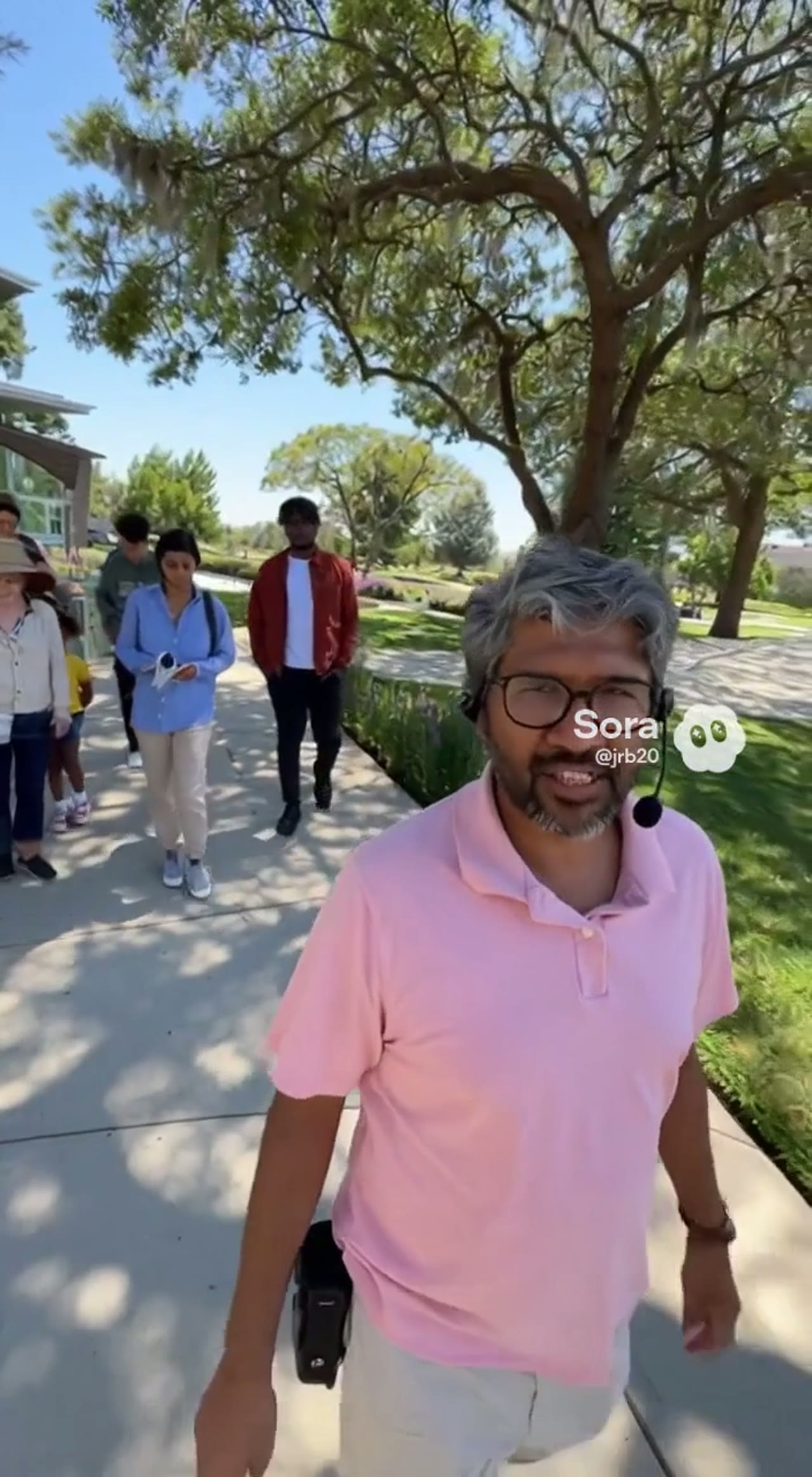
A cameo as an instrument
Most cameos are used as signatures: proof that a recognizable person was there. The @jrb20 cameo works differently. It behaves less like a celebrity appearance and more like a reusable design material—a consistent human figure that can be placed inside an uncertain situation.
Across the archive, the cameo leads a tree walk, tests a spatial music library, handles printed cards, rides in an autonomous cab, dances with clones, inspects a garage floor, and gives a talk for a project that has not yet fully arrived. The roles change, but the person remains recognizable. That continuity makes comparison possible. What changes when the same person moves from founder to customer, from designer to performer, from careful observer to comic victim of the system?
The answer is not a conventional user test. No generated clip can validate demand, prove usability, or stand in for another person's lived experience. But it can make an idea specific enough to challenge. It can expose missing props, implausible sequences, awkward social dynamics, and questions the abstract concept never forced us to ask.
From proposition to situation
Design work often begins in compressed language: “a self-guided tree walk,” “a physical music archive,” “an AI lamp,” “a printed booklet with a QR path back to video.” Those phrases are useful, but they hide almost everything that matters. Where does the person stand? What do their hands do? Who else is present? What does success look like? What is embarrassing, delightful, or confusing?
Generative video expands the phrase into a scene. When @jrb20 lifts a birding guide toward an open sky, the project is no longer only a publishing concept. It has a scale, a setting, a posture, a moment of discovery, and an implied next action. When he browses a wall of photographs in VR, the archive acquires reach, density, and bodily effort. When he sits startled in a speeding Cybercab, the sleek future of autonomy suddenly includes trust and fear.
This is why the recurring cameo matters. It supplies a stable point of view. The same body and persona can be run through multiple possible worlds, producing a peculiar longitudinal study of imagination—not “What can the model render?” but “What kinds of situations become easier to think about once I can see myself inside them?”
Role-play before reality
Putting yourself in the scene is a form of role-play. It lets the maker temporarily occupy the position of the future user, guide, presenter, passenger, artist, or organizer. That role-play is intentionally provisional. It is a rehearsal, not evidence.
Still, rehearsal has value. A prototype does not need to be true in order to be revealing. It needs to be concrete enough to produce reactions. A generated scene can create that friction quickly: delight at a physical interaction, skepticism about a polished launch fantasy, recognition that a project needs people rather than just screens, or the realization that the most interesting part is not the product but the ritual around it.
In that sense, the cameo is a low-cost cast member for speculative prototyping. It turns prompts into situations and situations into questions. The resulting videos are not endpoints; they are thinking surfaces.
A portfolio of possible selves
The breadth of the archive is part of the method. Serious product scenarios sit beside dance, historical fiction, domestic comedy, and impossible spectacle. That range prevents the cameo from becoming a single polished spokesperson. It remains flexible and slightly unruly.
The comic scenes are particularly useful. They reveal timing, personality, social context, and failure—qualities that product renderings often suppress. A perfect concept video shows the intended path. A strange one can reveal the human path: distraction, hesitation, vanity, fear, family interruption, laughter, or improvisation.
Taken together, these appearances form an unusual self-portrait. It is not a documentary record of what happened. It is a record of what was imagined, tested, exaggerated, or made discussable. The cameo does not say, “I did all of this.” It says, “I used myself to ask what this might feel like.”